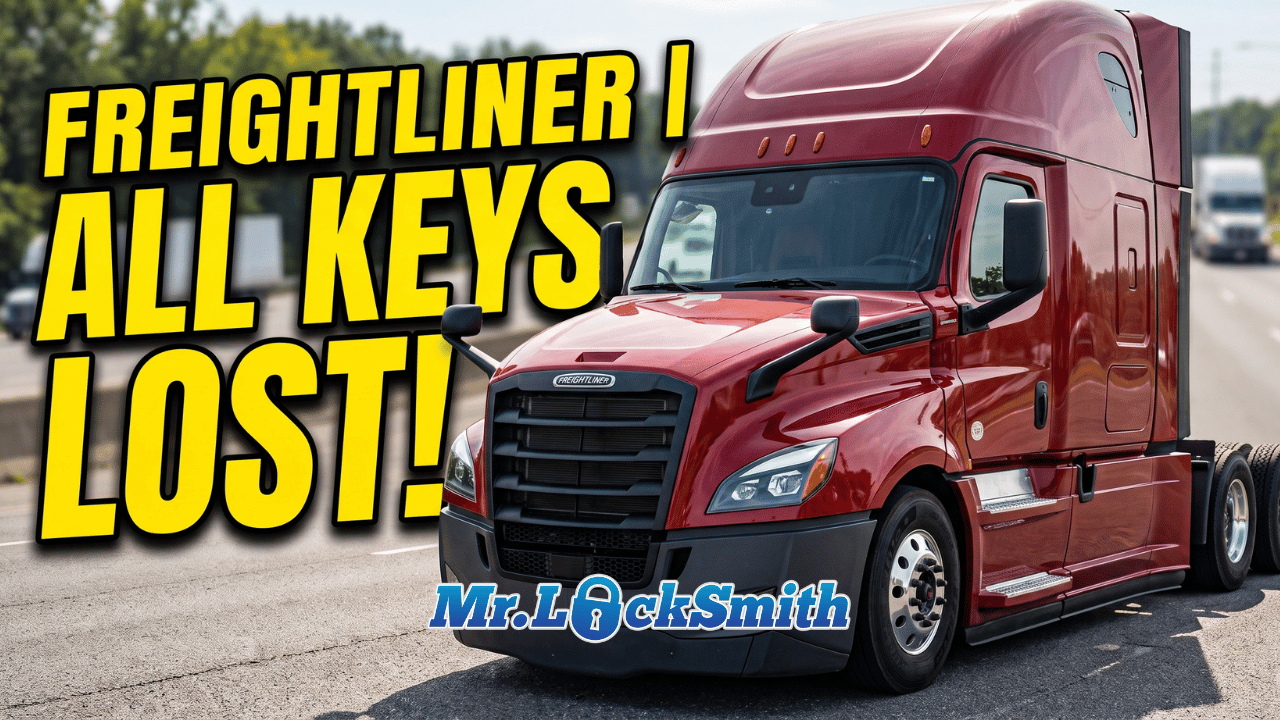
Commercial Truck Locksmith: When a heavy-duty commercial truck suffers an All Keys Lost emergency, extended downtime costs transport companies thousands in missed deliveries and driver delays. A specialized commercial truck locksmith provides immediate, on-site key replacement, transponder chip programming, and ignition lock repairs for Class 4 through Class 8 vehicles. Armed with advanced J1939 diagnostic software and high-security key cutting equipment, mobile truck locksmiths bypass costly dealer tow charges by decoding lock cylinders directly at the roadside. Whether managing a single semi-truck or an entire transport fleet, professional commercial truck locksmith services restore vehicle access quickly to keep supply chains moving efficiently. (Source: Terry Whin-Yates)
Source: Mr. Locksmith Youtube http://www.youtube.com/user/24hrMrLocksmith
Commercial Truck Locksmith
Mr. Locksmith Automotive (604) 259-7617
Mr. Locksmith 604-330-9915
The major commercial truck brands in North America—spanning Class 4 through Class 8 (medium-duty to heavy-duty semi-trucks)—are organized below by their parent manufacturing groups:
Daimler Truck North America
-
Freightliner: The largest market share holder in North America, known for highway haulers like the Cascadia and versatile medium/vocational models like the M2 series.
-
Western Star: Specializes in heavy-duty severe-service, vocational, logging, and custom highway trucks.
PACCAR
-
Kenworth: Widely known for premium long-haul conventional trucks like the W900 and aerodynamic models such as the T680.
-
Peterbilt: Iconic heavy-duty truck builder known for custom vocational setups and highway models like the 579 and traditional 389/589.
Traton Group
-
International Trucks (Navistar): Major producer of medium-duty, vocational, and highway trucks including the LT Series, MV Series, and regional haulers.
Volvo Group
-
Volvo Trucks North America: Known for highway models focused on safety and driver comfort, such as the VNL series.
-
Mack Trucks: Longstanding American brand focused on vocational, construction, refuse, and regional haul trucks like the Granite, Anthem, and TerraPro.
Medium-Duty & Work Truck Manufacturers
-
Isuzu Commercial Truck of America: Dominant market player in Class 3–5 low-cab-forward (LCF) cabover work trucks (N-Series).
-
Hino Trucks (Toyota Group): Offers conventional medium-duty and cabover commercial trucks.
-
Ford Commercial Vehicles: Produces Super Duty (F-250 through F-600) and medium-duty chassis cabs (F-650/F-750).
-
Chevrolet / GMC: Manufactures medium-duty chassis cabs (Silverado 4500HD/5500HD/6500HD and Low Cab Forward series).
-
RAM Commercial: Produces heavy-duty chassis cab work trucks (RAM 3500/4500/5500).
Specialized, Vocational & Alternative Energy
-
Autocar: Oldest operating truck brand in North America, focused on heavy-duty refuse, yard tractors, and severe-duty vocational chassis.
-
Nikola Motor: Manufacturer of zero-emission Class 8 hydrogen fuel cell and battery-electric semi-trucks.
Commercial Truck Locksmith: The Ultimate Guide to Heavy-Duty Vehicle Key Replacement & Security
Introduction
In the commercial transport industry, time is directly tied to revenue. When a Class 7 or Class 8 semi-truck sits immobile at a weigh station, truck stop, or job site due to a lost key or ignition failure, the financial losses stack up quickly. Over my 35-plus years as a third-generation locksmith and instructor, I have seen commercial vehicle security transform from simple mechanical brass keys into sophisticated, encrypted immobilizer networks. Managing key replacement for modern transport vehicles requires specialized diagnostic equipment, high-security cutting machinery, and deep familiarity with commercial CAN bus architectures.
Whether operating a single rig or managing an interstate transport fleet, encountering an “All Keys Lost” emergency requires a precise, professional workflow. Searching for a mobile truck locksmith or a commercial truck locksmith near me shouldn’t lead to towing delays or multi-day dealer wait times. In this guide, I will walk you through the technical reality of heavy duty truck key replacement, cover the advanced security systems used in modern rigs like Freightliner, outline essential locksmith tools, and share practical field insights to keep your commercial fleet moving safely and efficiently.
The Evolution of Heavy-Duty Truck Security: 2025 Freightliner & Modern Systems
Commercial truck security has evolved significantly. Legacy commercial trucks relied almost exclusively on mechanical edge-cut keys that operated basic ignition cylinders with no electronic anti-theft checks. Today, modern transport vehicles—exemplified by the 2025 Freightliner lineup, including the Cascadia, M2 106, M2 112, and SD vocational series—employ multi-layered electronic security networks.
Modern Commercial Truck Immobilizers & Encrypted Gateways
Modern commercial truck key programming involves far more than cutting a piece of metal. The immobilizer system relies on precise digital handshakes between multiple control modules:
-
Encrypted Transponder Chips: Embedded transponders inside the key head communicate via low-frequency radio signals with an antenna ring around the ignition cylinder.
-
Central Gateway Modules: Modern Freightliner models route security validation through a central gateway that verifies digital credentials before sending a start command to the Engine Control Module (ECM).
-
Proximity & Smart Fob Architectures: High-tier long-haul configurations feature keyless entry and push-to-start proximity fobs that use rolling-code encryption transmitted over high-speed CAN networks (such as J1939).
If an unprogrammed key turns the ignition cylinder, the central gateway blocks fuel injection and starter engagement, triggering diagnostic fault codes across the digital dash cluster.
| Security Generation | Key Design | Key Blank Profile | Immobilizer Technology | Programming Protocol |
| Legacy Systems (Pre-2010) | Single/Double Edge | Traditional Brass | None / Basic Fixed Transponder | Direct Mechanical Cut |
| Mid-Era Systems (2011–2019) | Transponder / Edge | High-Security / Edge | Crypto Transponder | Module-Linked ECU |
| Modern Fleet Systems (2020+) | High-Security / Fob | Laser-Cut Track | Central Gateway Encryption | J1939 HD-OBD Diagnostic |
Essential Tools for Professional Commercial Truck Locksmiths
Generating a functional key for heavy-duty commercial machinery on-site requires a dedicated tool suite built for industrial applications.
-
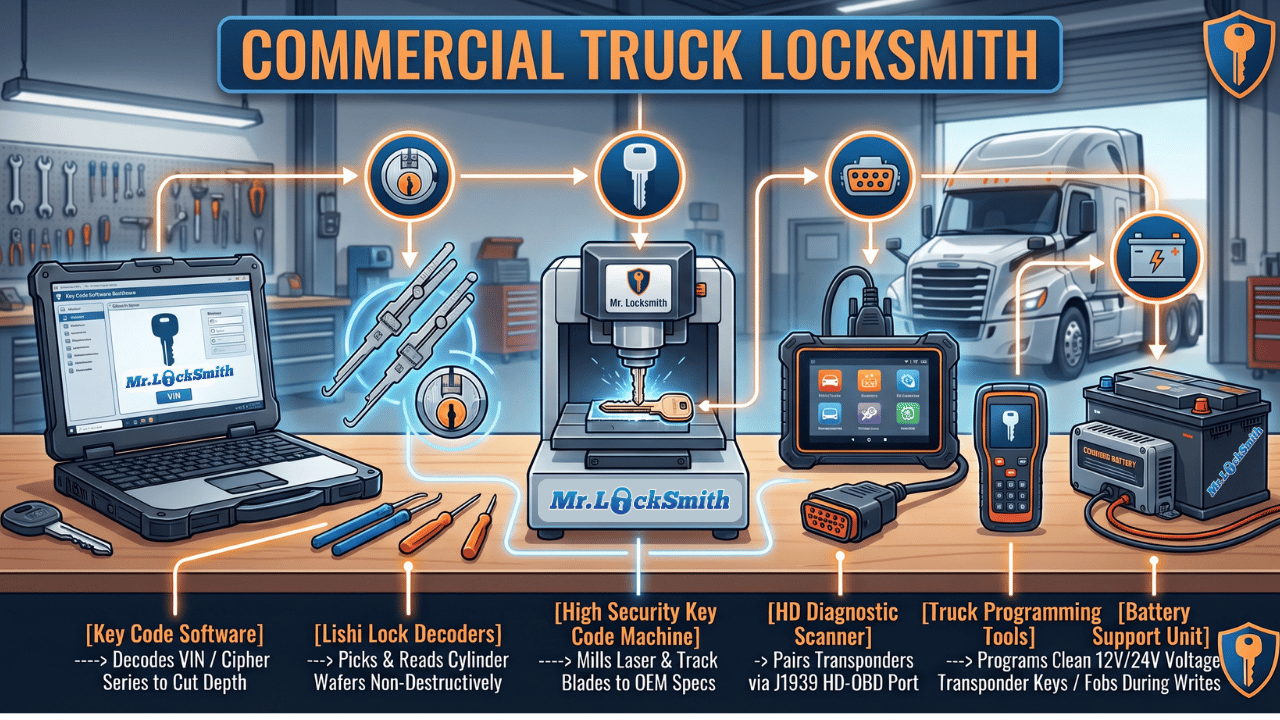
Key Code Databases & Software: Converts manufacturer key codes into precise depth-and-space dimensions for automated milling.
-
Lishi Pick & Decoder Tools: Allows non-destructive picking and wafer decoding directly through the door lock cylinder without removing door panels.
-
High-Security Electronic Key Machines: Battery or inverter-powered CNC milling machines (e.g., HPC Laser, Silca Futura) that produce factory-grade track cuts.
-
Heavy-Duty Diagnostic Programmers: Specialized handheld tools equipped with 9-pin Deutsch and 16-pin OBD-II connectors engineered to communicate over J1939 commercial vehicle protocols.
-
EEPROM Programmer Equipment: Used in advanced scenarios to read chip memory directly from control modules when OBD programming access is restricted.
-
Clean Battery Maintainer: Maintains steady voltage across commercial battery banks during diagnostic flashing to prevent ECU corruption.
Proof of Ownership: The Non-Negotiable First Step
Before unlocking a cab, retrieving code data, or cutting a blade, a professional 24 hour truck locksmith must verify legal authorization. Commercial vehicles often carry high-value freight, making strict security compliance essential.
A technician must verify:
-
Valid government-issued photo identification.
-
Official vehicle registration certificate or commercial transport title matching the presented ID.
-
Corporate authorization documentation (for fleet vehicles), confirming the requesting agent has authority to request a commercial fleet locksmith service call.
Security Guardrail: An ethical locksmith will decline any job if ownership documentation does not match the vehicle details or if corporate credentials cannot be verified.
The “All Keys Lost” Workflow: Step-by-Step Key Creation
When an operator loses all working keys, a heavy truck locksmith near me follows a systematic on-site procedure to restore vehicle operation:
-
Ownership & Identity Verification: Validate driver ID, vehicle registration, and fleet dispatch authorization.
-
Voltage Stabilization: Connect a commercial-grade battery maintainer to the truck’s electrical system.
-
Non-Destructive Entry & Cylinder Decoding: Use specialized Lishi tools to pick the door cylinder into the unlocked position and decode wafer depths from positions 1 through 8.
-
Mechanical Key Origination: Input decoded depths into an automated key machine to mill a precise high-security mechanical key blade.
-
Mechanical Test Inspection: Test the cut blade in the door and ignition lock cylinders to ensure smooth mechanical operation without binding.
-
OBD-II / J1939 Diagnostic Session: Plug the diagnostic programmer into the 9-pin Deutsch connector under the dash and switch ignition to ON.
-
Immobilizer Transponder Pairing: Access the vehicle security menu, clear lost key signatures (if required by fleet protocol), and register new transponder chip codes into the gateway module.
-
Engine Start & System Verification: Crank the engine, confirm zero dashboard security fault codes, and test remote lock/unlock functionality.
Key Cloning vs. Diagnostic Programming
Understanding the technical difference between key cloning and diagnostic key programming is critical for fleet managers and apprentice locksmiths alike:
-
Key Cloning: Reads the digital signature of an existing, working key and writes an exact copy onto a programmable clone chip. Cloning requires a functional master key and does not add a new key slot inside the truck’s ECM.
-
Diagnostic Programming: Connects directly to the vehicle’s central gateway over J1939 protocols to write a completely new, unique transponder key signature into module memory. This method is required during an emergency truck locksmith callout when no working key exists.
Troubleshooting Failed Key Programming Attempts
Even experienced technicians encounter programming hiccups in the field. Here are common issues and field-tested solutions:
-
Communication Loss During ECU Flash:
-
Cause: Voltage drops below 12.2V or battery noise.
-
Solution: Verify battery support equipment is active and supplying clean power before restarting the flash sequence.
-
-
J1939 Bus Signal Interference:
-
Cause: Third-party telematics, Electronic Logging Devices (ELDs), or GPS trackers tapped into the CAN bus.
-
Solution: Unplug aftermarket ELD pass-through harnesses from the back of the diagnostic connector prior to starting a programming session.
-
-
Security Countdown Lockout:
-
Cause: Repeated incorrect PIN entries or premature key cycling.
-
Solution: Maintain ignition ON status for the full security wait period (typically 10 to 15 minutes) without cycling the key or disconnecting power.
-
Why Choose a Professional Truck Locksmith Over a Dealership?
When facing a lost Freightliner key or an All Keys Lost emergency, fleet operators must choose between calling a mobile locksmith or towing the vehicle to a main dealership.
| Operational Factor | Professional Mobile Truck Locksmith | Commercial Truck Dealership |
| Service Location | On-Site Roadside / Depot Dispatch | Service Bay Only (Requires Towing) |
| Average Response Time | Same-Day / Immediate Emergency Dispatch | Appointment Delays (Often 24–72 Hours) |
| Towing Expense | $0 (Technician Travels to Vehicle) | High-Capacity Heavy Towing ($500–$1,500+) |
| Service Flexibility | 24/7 Roadside & After-Hours Service | Restricted to Standard Business Hours |
| Overall Cost Impact | Lower Total Cost; Drastically Less Downtime | Higher Labor Rates + Towing + Storage Fees |
Fleet & Preventative Maintenance Recommendations
Proactive key management helps fleet managers prevent emergency lockouts and minimize unexpected downtime:
-
Maintain a Secure Key Code Database: Keep a record of mechanical key codes and transponder chip types for every VIN in your fleet.
-
Implement a Standard Two-Key Policy: Ensure every vehicle operates with two registered keys. If one is misplaced, duplicate a working key immediately via cloning to avoid an expensive commercial truck all keys lost situation.
-
Separate Heavy Keychain Attachments: Avoid hanging heavy rings loaded with tools, flashlight sets, or extra keys from the ignition cylinder. Heavy keychains damage internal ignition lock wafers during highway vibration, causing premature lock failure.
-
Service Lock Cylinders Periodically: Apply high-grade dry graphite or silicone-based lock lubricants to door and ignition cylinders during regular maintenance checks. Never use heavy oils or grease that attract dust and dirt.
Tips From a Third-Generation Locksmith
Pro Tip from Terry Whin-Yates:
“In over 35 years in the locksmith industry, I’ve seen more control modules damaged by low voltage than almost anything else. When performing heavy duty truck key replacement, electrical stability is paramount. Always hook up clean battery support before touching a diagnostic programmer. Test your mechanical cut on an inexpensive test blank first, clear any telematics hardware off the CAN bus, and double-check your credentials before starting the program.”
Beginners’ Mistakes to Avoid
-
Skipping the Mechanical Cut Test: Always verify smooth mechanical lock cylinder rotation on a test blank before programming an expensive transponder or smart fob.
-
Forgetting Aftermarket Telematics: Leaving an active ELD unit plugged into the J1939 port can distort signal lines and corrupt module programming sessions.
-
Over-Torquing Lock Picks: Applying excessive tension while picking commercial wafers can bend internal brass components, resulting in costly semi truck ignition repair.
Frequently Asked Questions
Can a Commercial Truck Locksmith make a key without the original?
Yes. Mobile commercial truck locksmiths can decode the vehicle’s lock cylinders using specialized picking and reading tools, mill a new physical key blade to original factory specifications, and program the transponder chip directly into the vehicle’s central gateway or engine control module (ECM).
How much does heavy-duty commercial truck key replacement cost?
On-site mobile key replacement generally ranges between $250 and $650, depending on the truck make, model year, location, and key type (standard transponder vs. proximity smart fob). Mobile locksmith service is typically far less expensive than dealer pricing, as it eliminates high heavy-duty towing fees.
Can commercial truck keys be programmed on-site at the roadside?
Yes. Professional truck locksmiths carry mobile workshops equipped with battery maintainers, automated CNC key cutting machines, and specialized diagnostic software capable of communicating over J1939 commercial truck protocol lines to pair keys right where the rig is stranded.
What is an “All Keys Lost” (AKL) procedure for semi-trucks?
An All Keys Lost procedure is the complete process performed when no working keys exist for a vehicle. It includes non-destructive cab entry, decoding the door or ignition cylinder wafers, cutting a precision mechanical key blade, and flashing new transponder security credentials into the truck’s onboard computers.
Can every locksmith make commercial semi-truck keys?
No. Class 4 through Class 8 commercial vehicles (e.g., Freightliner, Kenworth, Peterbilt, Volvo, Mack) use heavy-duty J1939 electronic architectures, specialized high-security key profiles, and high-voltage electrical setups that standard residential or light-automotive locksmiths are not equipped to handle.
How long does on-site commercial truck key replacement take?
Under normal field conditions, a qualified commercial truck locksmith can complete customer verification, lock decoding, key cutting, and diagnostic immobilizer programming in approximately 45 to 90 minutes.
Do modern commercial trucks use transponder security systems?
Yes. Most heavy-duty trucks built over the last decade feature transponder chips embedded within the key head or smart fobs that communicate with an immobilizer or central gateway module to prevent engine starting without authorized digital credentials.
What documents are required before a locksmith can make a key?
To comply with security and legal requirements, the technician must verify valid government-issued photo identification, official vehicle registration or commercial title documentation, and corporate dispatch authorization if servicing a fleet vehicle.
Can fleet managers request spare keys for multiple trucks in bulk?
Yes. Fleet managers can arrange bulk key duplication, master keying schedules, or emergency backup key generation across an entire transport fleet with proper corporate verification and account credentials.
What is the difference between key cloning and diagnostic key programming?
Key cloning copies the digital signature of an existing, working key onto a duplicate chip without plugging into the truck. Diagnostic programming connects directly to the vehicle’s diagnostic port via heavy-duty programmers to write a new, distinct transponder identity into the truck’s module memory—which is required when all keys are lost.
Why is clean battery voltage critical during truck key programming?
Commercial truck programming requires stable voltage across 12V or 24V battery systems. If voltage sags during diagnostic flashing, data transmission to the ECU can be interrupted, potentially corrupting the central gateway’s memory.
Why might an aftermarket ELD or GPS tracker interfere with key programming?
Electronic Logging Devices (ELDs) and telematics hardware plug directly into the truck’s diagnostic CAN bus. These devices can create signal noise on communication lines, which may block the locksmith’s diagnostic scanner from writing new key data until the telematics unit is temporarily disconnected.
Can a locksmith make a Freightliner key without the original?
Yes. A qualified mobile truck locksmith can decode the door or ignition cylinder using Lishi tools, mill a new blade to factory specs, and program the transponder chip directly into the vehicle’s computer system without an original key.
How much does Freightliner key replacement cost?
Prices vary based on key style (mechanical blade, transponder, or proximity fob) and location. On-site mobile services generally range between $250 and $650, offering substantial savings over dealer towing and shop rates.
Can a Freightliner key be programmed on-site?
Yes. Equipped with specialized heavy-duty diagnostic equipment capable of communicating over J1939 CAN protocols, a mobile technician can complete transponder and remote programming right where the truck is parked.
What is an All Keys Lost procedure?
An “All Keys Lost” procedure is a multi-step service required when no working keys exist. It involves non-destructive entry, lock cylinder decoding, precision key blade milling, and diagnostic registration of new key credentials into the immobilizer system.
Can every locksmith make Freightliner keys?
No. Freightliner key replacement and key generation for other Class 7 and Class 8 trucks require specialized J1939 diagnostic software, high-security cutting tools, and training in commercial vehicle electrical architectures.
How long does Freightliner key replacement take?
An experienced commercial locksmith can complete ownership verification, lock decoding, key cutting, and immobilizer programming in roughly 45 to 90 minutes under normal field conditions.
Do Freightliner trucks use transponder keys?
Yes. Most Freightliner trucks built over the past decade, including the 2025 Cascadia and M2 series, feature encrypted transponder chips or smart keys integrated into their immobilizer networks.
Is dealer programming always required?
No. Independent commercial truck locksmiths equipped with modern heavy-duty programming tools can pair keys on-site without transporting the truck to a dealership.
What information is needed before making a replacement key?
You must provide government-issued photo identification, official vehicle registration or commercial title documentation matching the ID, and the Vehicle Identification Number (VIN).
Can fleet managers request replacement keys?
Yes. Fleet managers can arrange spare key creation, bulk duplication, or emergency key replacement across their entire fleet with proper corporate verification and account credentials.
How do I know if my semi-truck key uses an edge-cut or laser-cut blade?
Edge-cut keys have traditional cut notches along one or both outer edges. Laser-cut (high-security) keys feature flat outer edges with track grooves milled into the face or center of the metal blade.
What should I do if a semi-truck key turns in the door lock but not in the ignition?
This usually indicates an ignition lock cylinder that was replaced previously, severe internal wafer wear, or an inaccurate duplicate cut. A locksmith can decode the ignition cylinder directly to resolve the conflict.
Conclusion
Losing every key to a commercial truck does not have to result in expensive towing bills, multi-day delays, or lost freight revenues. With the right diagnostic equipment, precision key-cutting tools, and a clear understanding of heavy-duty security systems, a professional commercial truck locksmith can restore your transport vehicle to operation quickly at the roadside.
At Mr. Locksmith, our team brings decades of field experience to every commercial lockout, key generation, and ignition repair service call. Whether you need immediate emergency service for a heavy-duty rig or want to advance your skills through our professional locksmith training programs, we deliver reliable, industry-leading solutions designed to keep commercial fleets moving.
Need Immediate Commercial Truck Key Services or Professional Locksmith Training?
Contact Mr. Locksmith today to schedule mobile heavy-duty service or enroll in our comprehensive automotive locksmith training courses!
Enroll Today
✅ For Updated Locksmith Workshop Training Dates and Location go to https://mrlocksmith.com/locksmith-workshop-training-dates/
👉 Check upcoming workshop dates and reserve seats for your maintenance team today at Mr. Locksmith National Tour Hands-on Locksmith Training!
Mr. Locksmith Automotive (604) 259-7617
Mr. Locksmith 604-330-9915
ONLINE RESIDENTIAL COMMERICAL LOCKSMITH / AUTOMOTIVE LOCKSMITH CLASS & WEBINAR
✅ Sign up here: https://mr-locksmith-training.thinkific.com/
✅ Sign up here: https://mr-locksmith-training.thinkific.com/courses/locksmith-course-Become-a-Locksmith
For Updated Locksmith Workshop Training Dates and Location go to https://mrlocksmith.com/locksmith-workshop-training-dates/
Source: Terry Whin-Yates Mr. Locksmith Linkedin